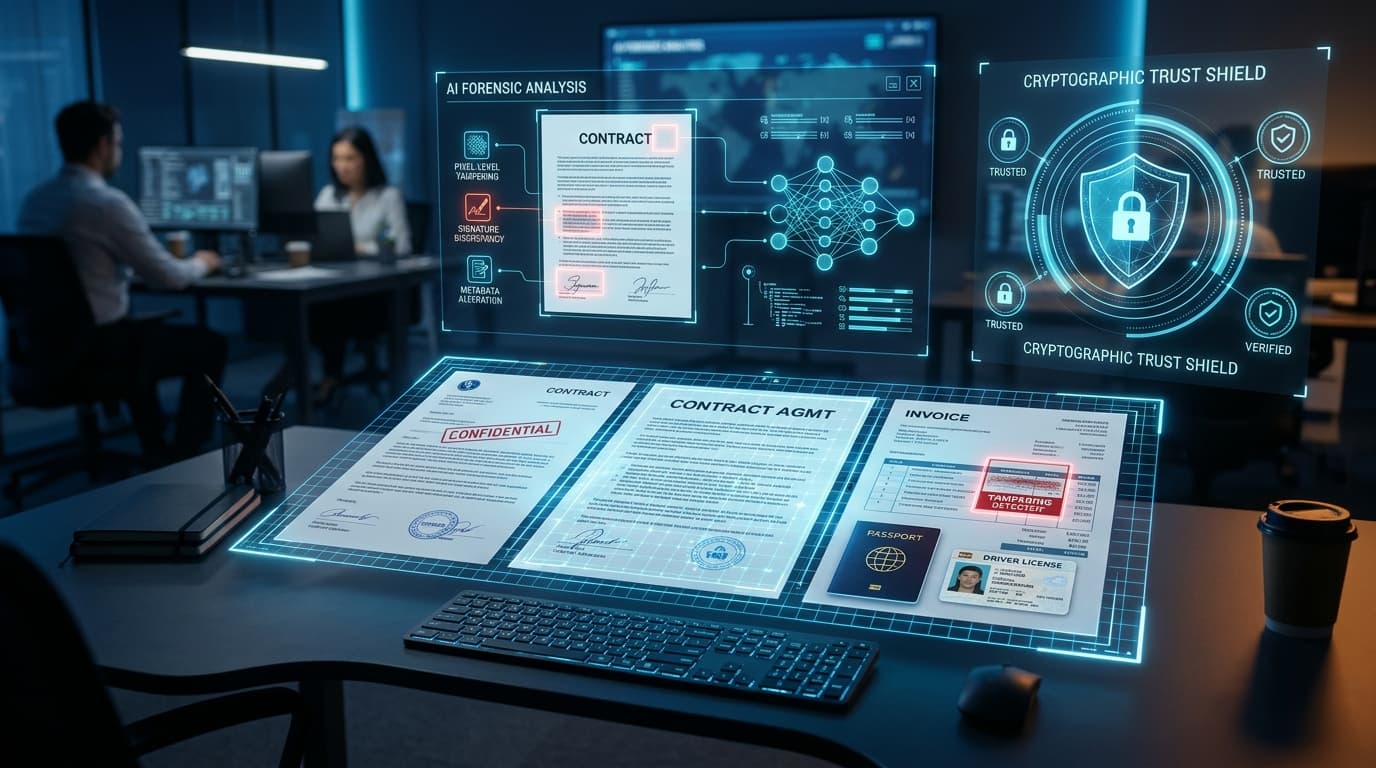
In modern corporate operations, document verification is virtually ubiquitous.
Whether opening bank accounts, approving credit facilities, settling insurance claims, onboarding key executive hires, conducting high-value property transactions, or executing cross-border trade, every pivotal business transaction relies on verifying customer identities, financial assets, transaction legitimacy, and legal authorizations through documentary evidence.
Yet, what is often treated as routine administrative compliance hides a massive and rapidly expanding security vulnerability.
The "Trust Deficit" and Zero Forgery Barrier in Digital Transformation
As operations transition fully online and physical papers give way to PDFs, scanned copies, and mobile captures, physical anti-counterfeiting features instantly dissolve, exposing organizations to three core threats:
Zero-Barrier Forgery
Democratized tools allow non-technical individuals to effortlessly erase micro-patterns, replace characters, and fabricate bank balances.
Photorealistic Deepfakes
Generative models reverse-engineer institutional layouts, official watermarks, and seals with near-indistinguishable visual fidelity.
Human Inspection Fails
The human eye cannot perceive sub-pixel gradient breaks, compression noise discrepancies, or incremental PDF revision layers.
When authenticity cannot be swiftly determined at the frontline, organizations face far more than operational delays—they suffer directly from bad debts, commercial fraud, and catastrophic regulatory penalties.
1. Which Business Scenarios Require Document Authenticity Verification?
Document verification risks are not confined to a single department; they span across critical operations involving capital transfer, credit authorization, and rights confirmation.
Account Opening, Credit & Asset Assessment
Banks, licensed money lenders, and fintech platforms process thousands of applications daily, reviewing ID credentials, e-statements, payroll slips, tax forms (IR56B), and proof of assets.
- Altering bank balance figures and transaction records to conceal existing liabilities and secure excessive credit.
- Submitting synthetic or forged identity credentials for account takeover, enabling money laundering and financial fraud.
- Mathematical contradictions between statement debits, interest deductions, and running balances that human reviewers miss.
Underwriting Disclosure & Claim Authenticity
Insurers rely on medical diagnostic reports, hospital billing receipts, disability assessments, and police accident reports to substantiate claim payouts.
- Inflating medical receipt amounts or adding fabricated treatment items to extract illegitimate payouts from minor incidents.
- Template forgery replicating medical institution letterheads and digitally copy-pasting physician stamps and signatures.
- Chronological anomalies between accident occurrences and clinic consultation dates that overburden manual reviewers.
Recruitment & Executive Background Screening
When onboarding critical technical, financial, or executive personnel, enterprises must rigorously verify academic degrees, professional credentials (CPA, CFA, legal bar), and employment references.
- High-fidelity diploma counterfeits matching typography, watermarks, and micro-embossing to disguise unqualified candidates.
- Fabricated electronic verification QR codes on overseas certificates that direct to phishing validation portals.
- Cross-border multilingual credentials creating high verification friction, leading to protracted manual back-and-forth.
Title Registration, POA & Property Transactions
Property conveyancing and mortgage financing involve Land Registry search records, sale and purchase agreements, owner identity documents, and statutory Powers of Attorney (POA).
- Forging Powers of Attorney to pose as authorized representatives, unlawfully liquidating properties or securing mortgages.
- Concealing land encumbrances and secondary mortgages, triggering massive title disputes and financial losses.
- Enormous capital exposure where a single verification oversight results in irreversible enterprise liability.
Vendor Management & 3-Way Payment Matching
Finance departments process requests for quotation (RFQs), purchase orders (POs), commercial invoices, delivery orders (DOs), and bank confirmation slips daily.
- Business Email Compromise (BEC) variations: modifying beneficiary bank accounts on legitimate invoices.
- Fabricating corporate seals and non-existent transactions to siphon enterprise procurement budgets.
- Subtle discrepancies in quantities, unit prices, and discount percentages between POs, DOs, and invoices.
Customs, Origin & Supply Chain Verification
Cross-border trade relies on commercial invoices, ocean bills of lading (B/L), customs declarations, packing lists, and certificates of origin.
- "Single Cargo, Multi-Financing": duplicating Bills of Lading to secure fraudulent financing from multiple financial institutions.
- Divergent multilingual layouts and HS tariff code mismatches creating extreme difficulty for automated verification.
- Subtle documentation discrepancies leading to severe customs impoundments, demurrage fines, and supply chain disruptions.
2. Why Manual Review Is Collapsing: Four Core Bottlenecks
While business domains differ, the underlying vulnerability is uniform: relying on human operators to manually scrutinize, transcribe, and visually verify documents has collapsed against modern digital fraud.
Cognitive Fatigue & Diminishing Marginal Scrutiny Under High Volumes
Human attention has immutable biological limits. When review officers inspect dozens of bank statements or dense customs declarations containing hundreds of rows, the brain enters automatic filtering mode. Sensitivity to minor numerical anomalies, subtle font shifts, and inverted dates degrades precipitously. During peak billing or tax seasons, backlogs force organizations into dangerous compromises between turnaround speed and risk standards.
"Seeing Is Believing" Fails Completely Against Pixel-Level Tampering
Document forgery has evolved far beyond rudimentary physical alterations. Modern syndicates use high-precision vector tools to invoke matching glyphs directly from a PDF's embedded font subsets, or utilize AI generative inpainting to rebuild backgrounds. The human eye can only spot clumsy formatting flaws; against surgical alterations of one or two numbers surrounded by pristine textures, visual review is completely defenseless.
Business Logic Blind Spots & Cross-Document Isolation
Authenticity extends far beyond optical legibility to encompass mathematical integrity and chronological consistency. For instance: Does the closing balance on a statement equal the opening balance minus debit sums? Does an invoice date precede the corresponding purchase order? Humans struggle to execute multi-way cross-validation across disparate files in real-time, resulting in severe verification blind spots.
Severe Regulatory Penalties & Institutional Legal Liability
Global regulators—including HKMA, SFC, and international AML/CFT enforcement bodies—have steadily escalated institutional liability for identity and document due diligence failures. If an entity accepts forged documents resulting in money laundering or fraud, regulators hold the institution strictly accountable with multimillion-dollar fines, revocation of operating licenses, and severe reputational damage.
Forensic Analysis: What Microscopic Traces Does AI Tampering Leave?
Understanding how forensic algorithms expose alterations that appear immaculate to the naked eye
When tampering with numbers in a PDF, fraudsters inevitably produce minute baseline shifts, anti-aliasing edge gradient mismatches, and kerning contradictions. Neural vision models identify sub-pixel anomalies across typographic baselines instantly.
Every 8x8 pixel block in lossy compressed images bears specific frequency coefficients. Modified and re-saved zones exhibit distinct compression loss rates compared to original areas, illuminating brightly against dark backgrounds during ELA analysis.
Cloning seals or signatures from genuine documents leaves semi-transparent feathering borders, color-space disparities, and background paper fiber texture disconnects that digital forensics detect effortlessly.
Standard PDF specifications employ incremental updates. While a modified figure seems to conceal previous text, the underlying object streams preserve the original characters, editor software fingerprints, and missing font subsets.
Comprehensive Comparison: Document Verification Models
Evaluating performance across Manual Review, Traditional OCR, and Multimodal AI Verification
| Evaluation Dimension | Manual Visual Review | Traditional OCR Tools | RealDoc Multimodal AI |
|---|---|---|---|
| Pixel Tamper Detection | Fails on micro-alterations | None (reads characters only) | Sub-pixel ELA & CNN forensics |
| Average Processing Latency | 5 – 25 minutes / file | 3 – 10 seconds / file | Sub-second (< 800ms) |
| Multi-Document Reconciliation | Prone to cross-file oversights | Unsupported (siloed files) | Knowledge graph cross-checks |
| Mathematical & Logic Checks | Manual calculator verification | Unsupported (no reasoning) | Automated balance & formula audits |
| Volume Scalability | Linear cost explosion | High concurrency throughput | High-concurrency microservices |
| Audit Trails & Evidentiary Value | Subjective notes, hard to standardize | Plain text output only | Visual forensic heatmaps & JSON |
3. Next-Gen AI Document Verification: Four Core Capabilities
Facing sophisticated forgery, enterprises no longer need passive "character transcription engines," but rather an intelligent cognitive brain capable of understanding business context, reasoning through mathematical logic, and detecting micro-forensic anomalies.
1. Multilingual Agentic OCR & Dynamic Semantic Structuring
Traditional OCR relies on rigid coordinates that break whenever documents are skewed or updated. Agentic OCR possesses autonomous spatial awareness, probing intricate multi-column tables, handwritten annotations, and multilingual layouts to translate unstructured pixels into validated, typed JSON data structures.
2. LLM Agent Mathematical Self-Auditing & Chronological Reasoning
Harnessing domain-tuned large language models, the system immediately runs comprehensive mathematical checks: comparing aggregate debit/credit lines with net balance changes, confirming invoice tax formulas, and assessing accident vs. clinic date chronologies to unmask files that look flawless optically but collapse mathematically.
3. Knowledge Graph Cross-Document Multi-Way Reconciliation
Breaking down single-document data silos. AI constructs interconnected knowledge graphs across IDs, bank statements, commercial invoices, and shipping bills in a given dossier, cross-examining entity names, registration numbers, item specifications, and maturity dates in milliseconds.
4. Pixel-Level Multimodal Image Forensics & Tamper Detection
Combining deep Convolutional Neural Networks (CNNs) and frequency-domain transforms to inspect microscopic anomalies. The engine simultaneously screens sub-pixel font antialiasing, JPEG compression noise (ELA), stamp edge feathering, and PDF revision histories.
4. RealDoc AI: Enterprise Intelligent Document Verification Architecture
Engineered for high-stakes corporate compliance, RealDoc elevates isolated OCR into an end-to-end defense hub uniting signal perception, forensic analysis, business reasoning, and multi-document reconciliation.
RealDoc 4-Tier Defense Architecture
End-to-end intelligent defense from low-level signal sampling to high-level policy decisioning
Agentic OCR Parsing
Spatial geometry awareness, auto-deskewing, shadow removal, and dynamic parsing of non-standard forms and handwriting.
Pixel-Level AI Forensics
Micro-forensic screening for ELA compression discrepancies, font antialiasing contours, and PDF incremental update trails.
LLM Logic Reasoning
Business logic validation engine, automatically auditing cash-flow balances, tax formulas, and chronological sequences in seconds.
Cross-Doc Reconciliation
Knowledge graphs cross-referencing multi-file dossiers, matching invoices, bills of lading, and ID credentials seamlessly.
Human-in-the-Loop (HITL) 3-Tier Enterprise Review Workflow
RealDoc does not advocate replacing human judgment blindly; instead, it establishes an optimal collaborative workflow combining algorithmic speed with human domain wisdom:
High-Confidence Pass (Score ≥ 95)
Documents passing pixel forensics and mathematical logic tests with high confidence enter straight-through automation, releasing 80%+ of routine manual load.
Exception Triaging (Score 70–94)
For blurred scans or minor calculation discrepancies, AI flags exact coordinates on an interactive heatmap, enabling staff to conclude reviews within seconds.
Risk Adjudication (Score < 70)
Cases showing definite tampering or severe logic contradictions are escalated directly to risk committees with comprehensive forensic forensic dossiers.
5. Rebuilding Digital Trust: The Strategic Enterprise ROI of AI Verification
Upgrading document authenticity verification is far more than an IT procurement decision; it is a foundational pillar safeguarding enterprise solvency, operational velocity, and regulatory standing.
Slashing Direct Fraud Losses
Preempting fraudulent financing, unauthorized credit drawdowns, and spurious insurance payouts at the frontline. For financial institutions, blocking even a few high-value forged applications per month saves millions in bad-debt provisions.
Exponential Velocity Gains
Compressing manual turnaround times from 3–5 business days down to sub-second real-time decisions. Organizations can scale application throughput tenfold without expanding headcount, delivering frictionless user onboarding.
Bulletproof Regulatory Standing
Generating immutable, standardized forensic audit logs with visual heatmaps for every reviewed file. Ensures effortless compliance with HKMA, SFC, and international AML/CTF evidentiary mandates.
In the AI Era, Authentic Documents Are the Bedrock of Digital Trust
As generative synthesis commoditizes visual counterfeiting, relying on human visual inspection has become an existential risk. Only by deploying a multi-layered verification architecture combining multimodal pixel forensics, mathematical logic audits, and cross-document knowledge graphs can modern enterprises build resilient trust barriers and thrive in the autonomous digital era.
Frequently Asked Questions (FAQ)
QWhy can't traditional OCR identify forged or tampered documents?
Traditional OCR is essentially a 'character transcriber' rather than a 'forensic validator'. It only maps image pixels into text strings based on coordinate templates. When a fraudster alters numbers on a bank statement or pastes a stamp, traditional OCR simply reads the altered numbers without detecting pixel noise, font antialiasing inconsistencies, or mathematical balance contradictions.
QHow does Error Level Analysis (ELA) uncover digital document tampering?
When a lossy compressed image (e.g., JPEG or embedded PDF raster) is modified and re-saved, the tampered area undergoes an additional compression cycle, resulting in significantly lower error potential compared to untouched regions. ELA computes frequency discrepancies across 8x8 pixel grids, causing modified text or cloned stamps to illuminate starkly against dark backgrounds.
QWhat is Cross-Document Multi-Way Reconciliation and why is it essential?
In complex corporate operations such as trade finance or procurement, fraudsters often forge one document (e.g., commercial invoice) while leaving accompanying documents genuine. Cross-document reconciliation uses knowledge graphs to cross-examine IDs, bank statements, POs, and bills of lading in milliseconds, detecting discrepancies in dates, entity names, tax rates, and serial numbers.
QHow does RealDoc achieve high verification accuracy while maintaining privacy?
RealDoc leverages on-premise or private-cloud microservice deployment architectures with zero raw-data persistence. Data is processed in volatile memory, verified via neural networks and LLM logic agents, and returned as tamper-proof audit reports, strictly complying with HKMA, SFC, and GDPR data governance requirements.
Applicable Fintech Verification Solutions
RealDoc AI Document Verification System
Combining Agentic OCR with proprietary neural networks for multilingual document understanding, multimodal tamper detection, and cross-document reconciliation across 119+ languages.
eKYC Intelligent Identity Verification
Integrating NFC chip reading, liveness anti-spoofing, and multi-tier ID authenticity checks to neutralize deepfake identity impersonation.
Related Reading: Identity Security & Compliance Insights
Curated fintech, regulatory guides, and industry insights
Cross-Industry AI Adoption Guide: Responsible AI Integration Across the Operating Model
Analyzing the SFC's landmark AI survey: how enterprises transition from isolated copilot tools to embedded Agentic AI while establishing safe and scalable governance.
Differences Between iAM Smart and eIDV: Debunking Common Myths
Explore the core differences between iAM Smart and eIDV, debunk 3 common misconceptions, and understand critical document image constraints.
Claude Introduces eKYC: Use Cases and Future Trends in AI Identity Verification
In-depth analysis of Anthropic's Claude introducing eKYC identity verification. Explore architectural design, 4 core use cases, and 6 future industry predictions.