Differences Between iAM Smart and eIDV:
Debunking Common Myths and Understanding Deployment Strategies
Throughout enterprise and institutional digital transformation, "iAM Smart" and "eIDV" (Electronic Identity Verification) are frequently discussed yet easily conflated. When planning customer due diligence (KYC) and compliance workflows, many organizations hold the misconception that "adopting iAM Smart equals completing the entire KYC process."
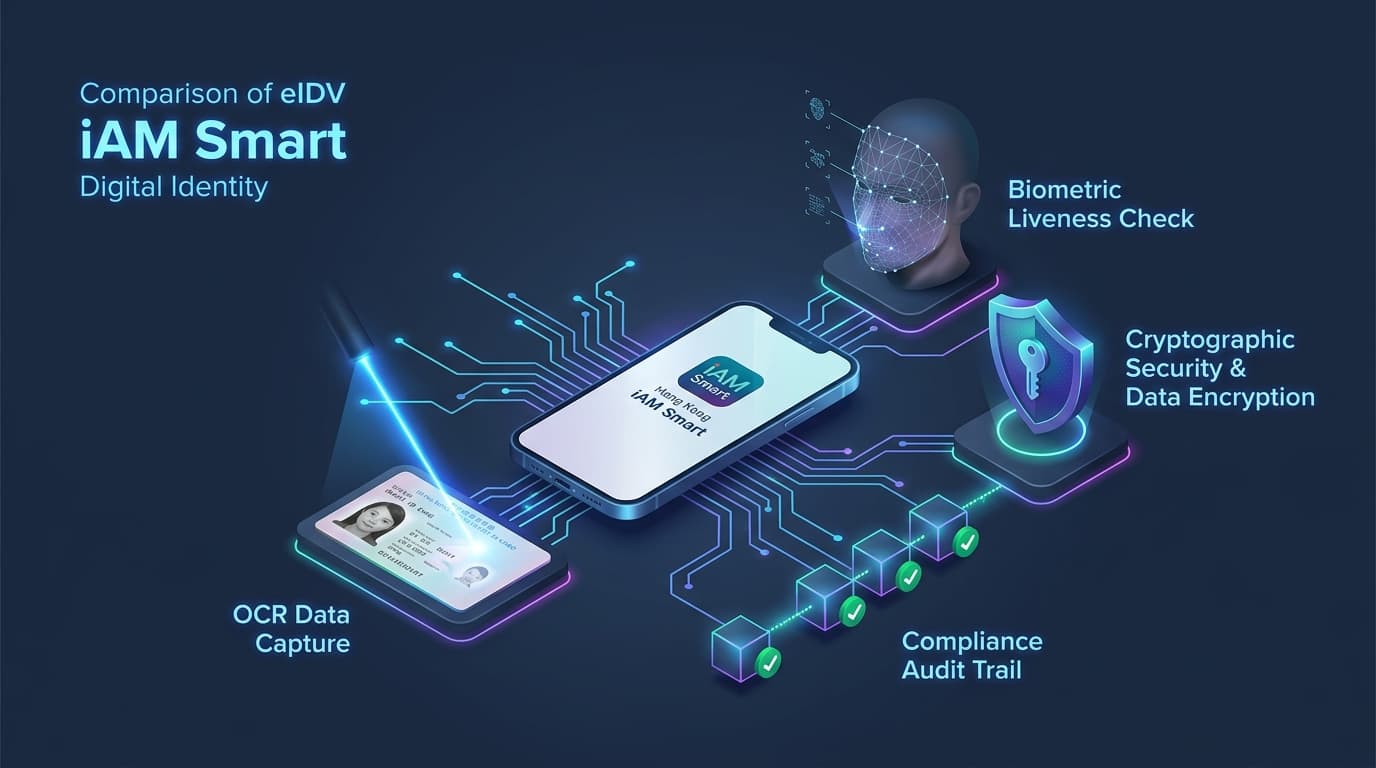
A government-backed "digital identity credential" providing verified textual attributes (name, HKID number, etc.), but strictly does not provide document photos or user selfies to third-party institutions.
An institution-managed "document + biometric verification" workflow where institutions acquire and retain ID document front/back images, selfies, and liveness audit reports for regulatory records.
1. Concept Decoding: iAM Smart vs eIDV
To chart an optimal digital customer identity journey, organizations must first understand the fundamental differences in definition, authority, and technological output:
| Comparison Dimension | iAM Smart (智方便) | eIDV (Electronic ID Verification) |
|---|---|---|
| Definition | A personal digital identity mobile application provided by the Hong Kong SAR Government. | A technical process and solution encompassing document capture, optical character recognition (OCR), liveness detection, and biometric matching. |
| Anchor Role | The Government serves as the central Trust Anchor. | Driven by enterprises and third-party technology providers. |
| Verification Model | User authorizes login / transfers verified textual personal attributes. | The institution prompts the user to capture the physical ID card in real-time and take a dynamic biometric selfie. |
| Document Image | Does NOT provide ID card photos/images or user selfies to third-party institutions. | Acquires & retains front/back ID images, user selfies, and detailed face matching confidence scores. |
| Applicable Scenarios | Frictionless login, Form Filling (e-ME), and legal digital signing. | High-risk onboarding, statutory AML/CFT compliance requiring document copies for audit trails. |
2. Debunking Three Common Myths
Myth 1: Does integrating iAM Smart equate to having a full eIDV system?
iAM Smart addresses Authentication and User-authorized text data transmission. However, for heavily regulated sectors (such as banking, insurance, and lending), regulatory bodies (like the HKMA and Insurance Authority) require institutions in specific scenarios to retain document images of client identification as part of the formal audit trail. iAM Smart does not store or deliver document images.
Myth 2: Once a user is verified via iAM Smart, does an enterprise no longer need KYC?
While the authenticity of iAM Smart's government data is unquestionable, institutional KYC policies still mandate proof of address verification, Politically Exposed Persons (PEP) screening, sanctions list matching, and document image archiving. Institutions must still deploy complementary KYC/eIDV tools to establish a complete compliance loop.
Myth 3: Are iAM Smart and eIDV mutually exclusive or conflicting solutions?
Enterprises can leverage iAM Smart to offer an ultra-smooth, zero-input login and onboarding experience, while seamlessly switching to or supplementing with eIDV technology when high-risk reviews (such as large credit lines or significant money transfers) demand OCR document capture and image archiving.
3. Critical Notice: iAM Smart Does Not Provide Document Images or User Photos
iAM Smart Mechanism
- Upon user consent, the system transmits verified textual attributes (e.g., English/Chinese names, HKID number, date of birth, gender) to the institution.
- Multi-factor authentication (iAM Smart+) performs facial recognition + NFC reading of the Smart ID chip, verified directly against Immigration Department records.
- Critical Limitation: iAM Smart will not and cannot transmit ID card images, chip images, or user selfies to institutions. Captured photos during registration are deleted immediately upon verification and are not retained. The API only delivers verified textual attributes.
eIDV Mechanism
- The user captures their physical HKID card (front/back) using their smartphone + performs a 3D biometric liveness selfie.
- The institution or vendor executes OCR extraction, security feature inspection, and facial image matching.
- Core Feature: The institution receives and archives document images and user selfies as its proprietary KYC/AML audit trail.
This is the single most critical technical nuance and regulatory clause that institutions tend to overlook:
To protect citizen privacy, ID card scans and facial recognition performed during iAM Smart enrollment occur strictly inside government servers as a one-time match. When users share data with third-party institutions (such as banks, insurers, or securities brokerages), iAM Smart only transmits verified textual fields. It will never share physical ID images or live biometric selfies with the requesting institution.
What Practical Impacts Does This Have on Institutions?
1Audit Trail Reinforcement Challenge
Challenge: If applicable statutory guidelines (such as the Anti-Money Laundering Ordinance) or internal compliance policies require institutions to retain a copy/image of the client's identity document, iAM Smart alone cannot satisfy this prerequisite.
Remedy: Institutions should seek confirmation from regulators on whether "iAM Smart digital authentication" qualifies as an approved statutory exemption for document image retention; if not, an inline step prompting users to upload or capture the document must be introduced.
2Constraints on Manual Secondary Review
Challenge: During manual exception handling (e.g., rare characters in names or mismatched profile details), risk management teams cannot visually inspect an ID card photo to verify spelling or appearance.
Remedy: Institutions must establish operational fallbacks (such as requesting supplementary document uploads or directing the user to a physical branch).
3Absence of Proprietary Biometric Baseline Library
Challenge: Institutions cannot establish their own user biometric facial templates. If they want to perform native facial recognition within their own mobile app later, they cannot use iAM Smart images as a reference template.
Remedy: Institutions must utilize an initial eIDV flow to establish an image and biometric baseline, or rely entirely on iAM Smart as the perpetual authentication gateway.
4. Summary and Institutional Deployment Recommendations
Government-backed "Digital ID Credential" → Delivers verified text attributes, does not provide document images or photos.
Institution-managed "Document + Liveness Verification" → Institution receives and retains document images and selfies.
- If the primary objective is to elevate user experience, eliminate input errors, and lower onboarding friction, iAM Smart is the premier solution.
- If operations are subject to strict regulatory supervision requiring archived document images for audit compliance, iAM Smart alone is insufficient. You must pair it with an eIDV solution or integrate supplementary document image collection.
💡 Pragmatic Architectural Takeaway:
For most institutions, the most practical approach is "iAM Smart Authentication + Supplementary Document Image Upload (when required)", rather than presuming a single mechanism solves all compliance demands.
For citizens, iAM Smart minimizes repetitive scanning hassles; in high-risk financial situations (such as banking or securities), complementing it with an eIDV step remains essential for audit readiness.
Recommended Solutions & API Gateways
iAM Smart Integration Solution
Official API integration with HKSAR iAM Smart+ for digital identity verification, form filling, and legal digital signing.
eIDV / eKYC Remote Onboarding
Multi-jurisdiction OCR, 3D biometric liveness detection, and complete document image archiving for audit readiness.
AML Name Screening Solution
Real-time PEP and sanction watchlist screening against UN, OFAC, and local enforcement records.
Related Articles & Technical Insights
Curated fintech, regulatory guides, and industry insights
How Airlines Combine iAM Smart and eIDV to Create the Ultimate Onboarding & Boarding Experience
Explore how airlines orchestrate Hong Kong's iAM Smart and global eIDV through intelligent demographic triage to deliver frictionless onboarding, online check-in, and APIS compliance.
Claude Introduces eKYC: Use Cases and Future Trends in AI Identity Verification
In-depth analysis of Anthropic's Claude introducing eKYC identity verification. Explore architectural design, 4 core use cases, and 6 future industry predictions.
The Relationship Between eKYC and Passkey: Who You Are vs. Are You Really You
In-depth analysis of the relationship between eKYC and Passkey. Understand how identity verification and passwordless authentication collaborate to build end-to-end digital identity security.
Build an All-Round "iAM Smart + eIDV" Architecture
Cash Direct empowers financial institutions, virtual banks, and licensed money lenders to rapidly integrate HKSAR iAM Smart APIs with enterprise-grade eIDV image capture and audit compliance workflows.
Technical & Integration Inquiries: [email protected]
Top Tier Security Standards · 99.8% Recognition Accuracy · Dedicated Technical Support Team