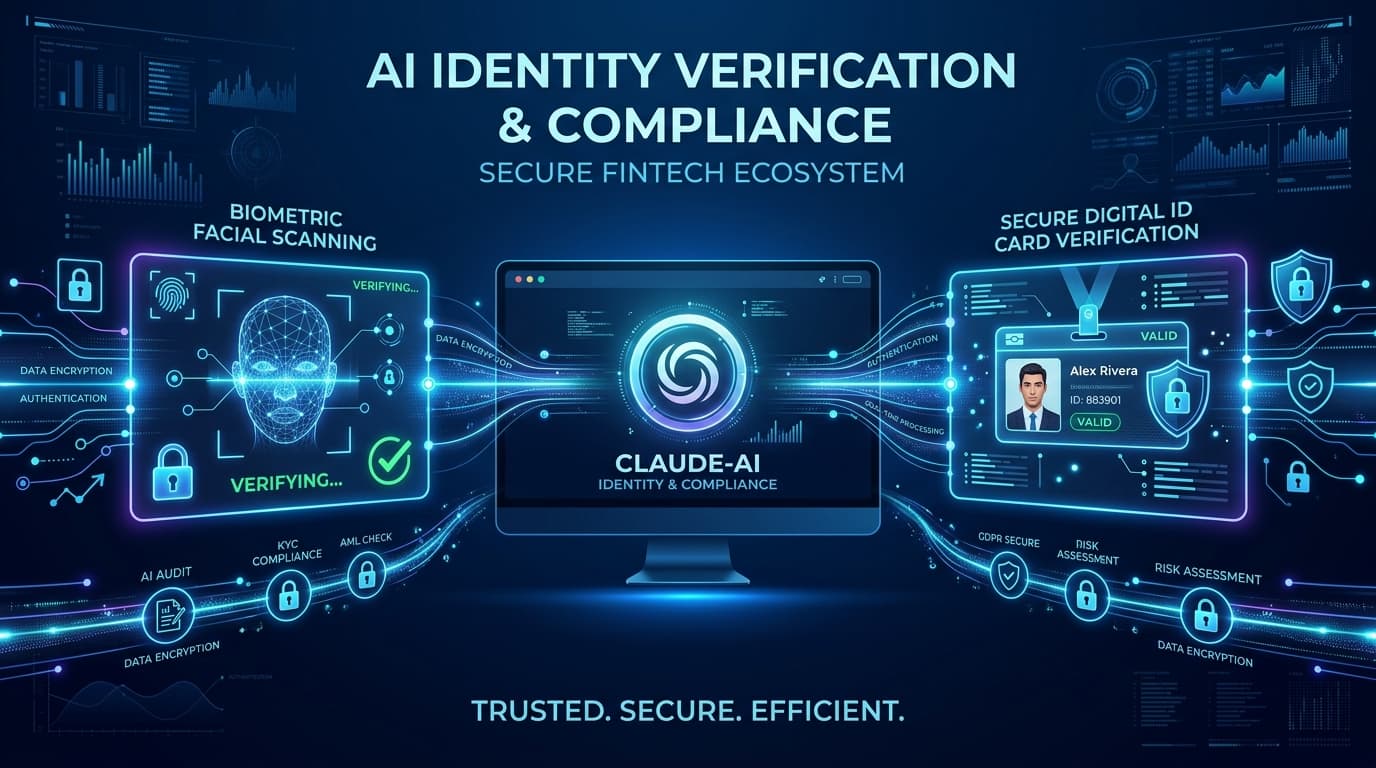
What is Claude eKYC and why is identity verification essential for Generative AI?
From Novelty to Infrastructure: The Inevitable Rise of Verified AI
The EU AI Act and digital identity frameworks mandate traceability and legal accountability for high-risk autonomous AI systems.
Before granting AI autonomous OS control and API execution, platforms require a verified legal entity to assume responsibility.
ID credentials are processed by certified 3rd-party KYC providers and strictly segregated from model training datasets.
💡 Industry Landmark: This is among the first comprehensive identity verification measures rolled out by a tier-one LLM provider, transforming conversational bots into audited enterprise systems.
Drivers and Architecture Behind Claude’s eKYC Rollout
Anthropic’s phased rollout of eKYC across Claude was necessitated by regulatory momentum and the proactive containment of advanced model misuse:
Mitigating Cyber & Fraud Threats
Frontier models can generate functional zero-day exploits, automate spear-phishing campaigns, and craft convincing social engineering payloads. Unchecked anonymous accounts risk turning frontier models into automated threat vectors.
Global Regulatory Compliance
Frameworks like the European Union AI Act, alongside age gating and digital platform governance rules across jurisdictions, mandate that service providers maintain mechanisms to trace real legal identities when severe violations occur.
Privacy Preservation via 3rd-Party Isolation
To ease privacy concerns, Anthropic relies on dedicated identity verification vendors to collect government IDs and live biometrics. Anthropic systems do not store raw ID images, guaranteeing no biometric data enters model training pipelines.
Four Key Use Cases of eKYC in Claude
eKYC functions as a risk-gated clearance mechanism. Here are the four primary deployment environments where real-name verification is paramount:
Unlocking High-Privilege Agentic AI Execution
When Claude interacts directly with operating systems, controls headless browsers, executes command-line scripts, or makes financial API calls, the potential for catastrophic misdirection or unauthorized actions spikes exponentially.
Penetrating Heavily Regulated Sectors (Finance, Healthcare, Legal)
Banking, licensed lending, healthcare, and legal sectors demand strict audit trails and customer due diligence (CDD). Anonymous AI platforms cannot legally process regulated customer records.
Enterprise API Fraud Prevention & Sybil Attack Defense
Bad actors frequently exploit bulk anonymous accounts to perform carding fraud, launder illicit funds, resyndicate token allocations, or mount Distributed Denial of Service / Sybil attacks against GPU clusters.
Strict Age Verification & Jurisdictional Export Control
Governments are tightening rules around underage access to generative content while enforcing strict tech export controls across sanctioned regions.
Six Industry Predictions (2026–2028)
Anthropic’s implementation is just the leading edge. Over the next three years, we anticipate profound transformations across the AI identity landscape:
Industry Standardization Across Major Labs
With OpenAI and Google experimenting with age and identity gating, Claude’s eKYC blueprint will become standard practice. By 2027–2028, real-name verification will be a baseline requirement for premium subscription and enterprise tiers.
Integration with Digital Identity Ecosystems
While physical document scanning remains prevalent, integration with national digital IDs (such as Hong Kong’s iAM Smart), mobile Driver’s Licenses (mDL), and W3C Verifiable Credentials (DID) will enable friction-free, cryptographically verified onboarding.
Risk-Based Verification Tiering
Platforms will employ dynamic tiering rather than blanket friction: casual Q&A will require lightweight authentication (SMS OTP or corporate email), whereas autonomous agents, high-limit API quotas, and medical diagnostics will demand biometric eKYC.
Corporate Federation & Differentiated API Tiers
Enterprises will require employees to bind corporate identities with AI accounts. Developer ecosystems will introduce tiered API latency and rate limits reserved exclusively for verified corporate accounts.
Zero-Knowledge Proofs (ZKP) vs. Regulation
To satisfy privacy advocates, cryptographic ZKPs will be adopted, allowing users to prove age and non-sanctioned status without revealing names or personal identification numbers to AI hosts.
Bifurcation of User Behavior and Markets
The market will segment into two distinct camps: privacy purists seeking decentralized open-source models (such as offline Llama deployments), and enterprise customers prioritizing legally backed, audit-ready AI platforms.
Key Takeaways for Hong Kong Financial Institutions
As a leading global financial centre overseen by regulators such as the SFC and PCPD, Hong Kong upholds rigorous principles of risk-based proportionality and data privacy. Claude’s eKYC framework offers essential benchmarks for local fintech innovators:
1. Compliance Prerequisites for Autonomous Underwriting Agents
Licensed money lenders and virtual banks evaluating AI Agents for loan pre-assessments, credit bureau parsing, or AML monitoring must maintain a verifiable audit trail linking machine actions to certified human operators.
2. Unifying eKYC and Passkeys into an Unbreakable Trust Chain
Cash Direct’s digital identity paradigm advocates pairing eKYC (verifying true legal identity at onboarding) with phishing-resistant Passkeys (authenticating sessions continuously). When AI agents execute transactions, this dual-pillar architecture is indispensable against impersonation.
Conclusion: From Compliance Friction to Commercial Trust
Every technological frontier eventually shifts from lawless experimentation to structural accountability. Anthropic’s eKYC initiative cements three foundational transitions:
Frequently Asked Questions (FAQ)
QWhy did Anthropic introduce eKYC for Claude in 2026?
The move was driven by dual imperatives: meeting stringent global regulatory mandates like the European Union AI Act and child-safety laws, while mitigating advanced cyber threats such as automated exploit generation, large-scale financial scam synthesis, API billing fraud, and establishing clear legal attribution for Agentic AI actions.
QWill user identity documents or biometric selfies be used to train Claude models?
No. Anthropic routes identity checks through independent, certified 3rd-party identity verification vendors. Raw ID credentials and biometrics are isolated from Anthropic's servers, and Anthropic has formally committed that no verification data will ever be incorporated into model training sets.
QWhat is Agentic AI and why does it necessitate eKYC real-name verification?
Agentic AI refers to autonomous models capable of operating computer operating systems, headless browsers, running command scripts, and calling transactional APIs. Because agents execute real-world operations with systemic consequences, platforms require verified human accountability before unlocking high-privilege autonomous permissions.
QHow will eKYC and AI identity verification evolve between 2026 and 2028?
Identity verification will evolve across three major axes: deep interoperability with national digital IDs (e.g. Hong Kong's iAM Smart, mobile driver's licenses, W3C DIDs), risk-based tiered verification (SMS OTP for basic chat vs. biometric eKYC for high-risk tools), and cryptographic Zero-Knowledge Proofs (ZKP) to prove age and compliance without disclosing raw personal identities.