In November 2026, the Securities and Futures Commission of Hong Kong (SFC) published its inaugural "Survey on the Application and Readiness of Artificial Intelligence among Large Institutions".
While the direct subjects were financial institutions, the findings, roadblocks, and governance principles apply universally to any sector accelerating AI adoption—manufacturing, retail, logistics, professional services, healthcare, and education. The survey covered 20 major institutions and 78 affiliated licensed corporations, accounting for more than 75% of relevant market trading turnover.
Universal Findings Across Industries
Institutions plan to actively accelerate AI adoption across business divisions within the next 12 months.
AI tools are already directly connected to internal core systems and private enterprise databases.
AI has transformed from standalone productivity tools into deep infrastructure embedded in operating models.
30% of institutions already use Agentic AI in production, with another 25% actively piloting autonomous agents.
These numbers convey one unequivocal takeaway: the next phase of AI competition is not about whether to adopt, but how to deploy safely, predictably, and at scale.
Common Operating Models Revealed: High Front-Office Penetration, Critical Gaps in Mid-Office
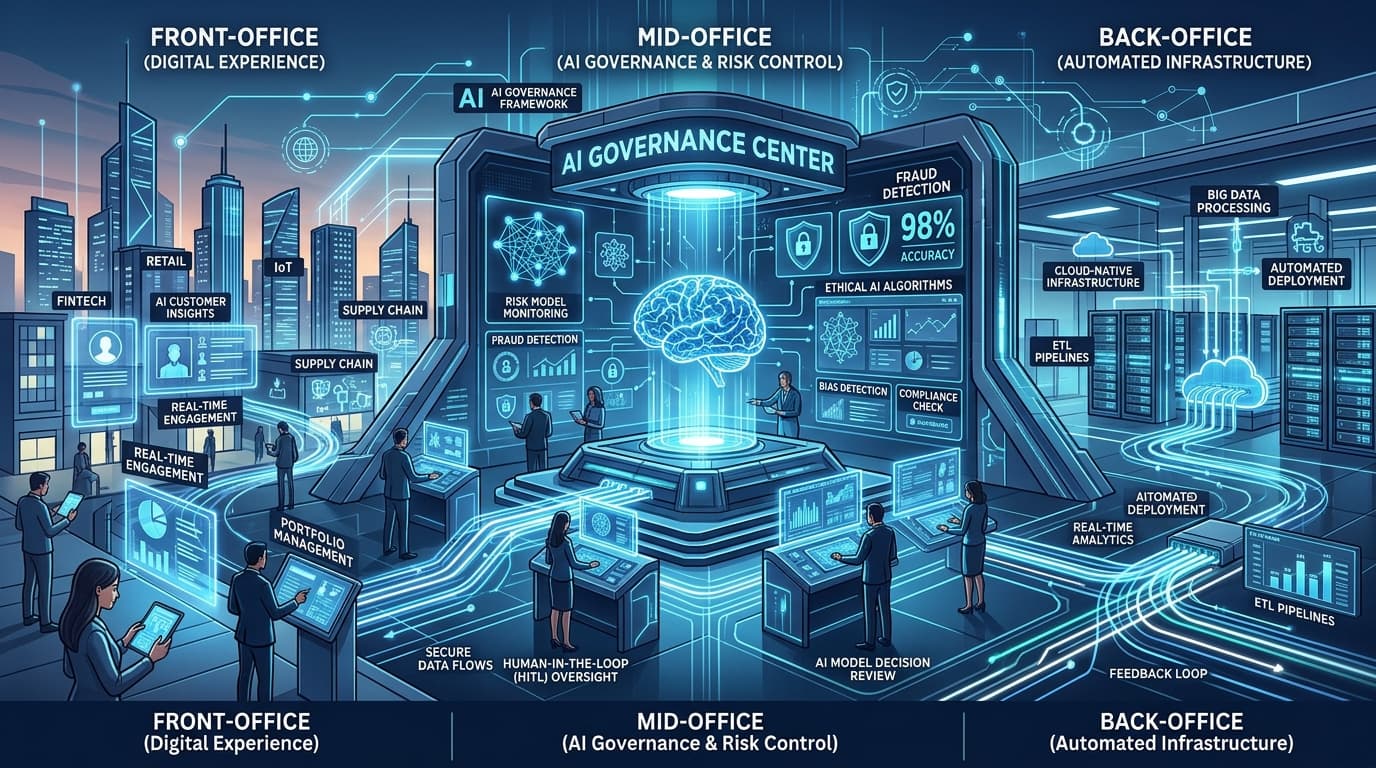
The SFC categorizes AI deployments into three primary segments: Front-Office, Mid-Office Monitoring, and Back-Office Support. This taxonomy directly maps across virtually every modern enterprise operating model:
Front-Office: Customer & Value
Early adoption and customer interaction
Mid-Office: Risk & Governance
Lowest adoption yet highest systemic risk
Back-Office: Infrastructure
Eliminating repetitive, labor-intensive costs
Universal Reality: Scalability is Dictated by Mid-Office Governance
Across industries, front-office and back-office gains surge rapidly, while mid-office "high-liability, high-risk" adoption lags. What truly dictates enterprise scalability is not model capability, but mid-office governance and risk control architectures.
The Real Bottleneck is Never Just the AI Model
The roadblocks cited by respondents mirror the universal challenges shared across every industry scaling AI operations:
Cost & Uncertain Commercial Value from Pilot to Production
While POC demonstrations are straightforward, scaling demands expensive inference resources and elusive ROI attribution.
Data Quality, Integrity, & Privacy Constraints
Cross-department data silos, unstructured noise, and strict privacy compliance (PDPO/GDPR) restricting sensitive data ingestion.
Deficit in Interdisciplinary Talent
Acute shortage of professionals who simultaneously understand business risk boundaries and Agentic AI architectures.
Accountability & Legal Attribution Dilemmas
When autonomous agents drift or make erroneous decisions, where does liability reside: prompt designers, operators, or vendors?
Validating Continuously Evolving Models
Generative models undergo continuous updates, rendering traditional deterministic software testing paradigms obsolete.
Balancing Autonomy with Meaningful Human Oversight (HITL)
Designing high-precision human-in-the-loop checkpoints that safeguard mission-critical workflows without introducing rubber-stamping fatigue.
Reliance on 3rd-Party Vendors & External APIs
Service disruptions, cross-border data transfer limitations, proprietary lock-in, and unpredictable API policy shifts.
SFC Regulatory Pillars: Universal Across All Industries
Safety First
Front-load data privacy, architectural robustness, and cybersecurity from day one, isolating raw corporate data from external model training.
Human-Centric
Maintain meaningful human oversight. Significant business decisions and risk actions must remain under accountable human command.
Collaborative Engagement
Foster cross-functional collaboration and clear audit trails between lines of business, risk officers, technology vendors, and regulators.
Universal Truth: Regardless of whether your sector is subject to stringent financial regulation, the moment AI touches customer trust, core decisions, or enterprise resilience, these three pillars dictate success or failure.
Universal Cross-Industry Implementation Framework
Rather than chasing maximalist parameter counts or endless features, organizations thrive by establishing a transferable, auditable, and sustainable operational roadmap:
First, Map Your Operational Landscape
Process MappingSegment active processes into front, mid, and back-office, explicitly cataloging where AI is embedded, where manual handoffs persist, and where systemic exposure is concentrated. This allows leadership to target high-impact yet controllable priorities.
Tackle 4 High-Frequency Friction Points: Documents, Anomalies, Identity, & Workflows
High-ROI FootholdsNearly all enterprises handle massive unstructured documents, fraud/anomaly detection, identity verification, and repetitive cross-system tasks. These domains offer quantifiable ROI and natural checkpoints for human approval.
Architect Human-in-the-Loop from Day One, Not as an Afterthought
Human-in-the-LoopThe transformative value of Agentic AI lies in autonomous multi-step execution. However, scalable platforms integrate granular approvals, telemetry observability, and emergency kill switches. Human oversight gives organizations the confidence to delegate broader permissions.
Treat Data Integrity & Privacy as Foundational Bedrocks
Foundation FirstAI outputs are solely as reliable as their prompt groundings and training context. Enterprise data schemas, role-based access control (RBAC), and immutable audit logs must be designed in tandem with initial model integration.
Prioritize Explainable, Auditable, and Private On-Premise Deployments
Architectural ControlFor core enterprise operations, select solutions providing transparent reasoning trails, mathematical verification, granular permission scoping, and private cloud or on-premise execution to eliminate black-box liability.
From Financial Blueprints to Universal Enterprise Capabilities
Financial services operate under the most stringent audit and risk governance mandates, naturally pioneering robust AI adoption patterns. Capabilities spotlighted in the survey—document fraud forensics, anomaly detection, digital identity verification, and workflow automation—are in fact universal enterprise capabilities applicable across every sector:
Document Intelligence & Anti-Tampering
Multi-modal verification and forensic examinationAnomaly & Risk Anomaly Detection
Time-series telemetry and internal fraud preventionIdentity & Permission Verification
Zero-Trust identity architecture and passwordless credentialsWorkflow Automation & Intelligence Extraction
Transforming unstructured knowledge into actionable executionThe Universal Essence: Securely Embedding AI in Real-World Operations
These foundational pillars are not restricted to finance. They collectively resolve the fundamental dilemma facing modern enterprises: how to securely, legally, and accountably embed AI into mission-critical operating models.
Conclusion: The Next Phase of AI is an Organizational Capability Race
The SFC survey delivers an unequivocal signal to every industry: AI has permanently graduated from experimental labs into mission-critical operating fabric.
Over the next 12 months, competitive disparity will not stem merely from who accesses newer or larger foundational models. Instead, it will be decided by who successfully erects a "safe, predictable, and scalable" adoption and governance framework. Regardless of your sector, the most urgent priority for leadership is not chasing transient buzzwords, but executing three foundational mandates:
Map Operational Landscapes and Risk Hotspots with Precision
Deconstruct front, mid, and back-office pipelines, delineating data pathways and regulatory liabilities rather than deploying models into blind spots.
Prioritize High-Frequency, High-Impact Scenarios with Human Oversight
Anchor efforts in document forensic inspection, anomalous activity monitoring, and identity verification—ensuring human experts retain decisive veto power.
Bake Security, Liability, and Auditability into Base Architectures
Eliminate retroactive patch-work by making explainable inference, granular role separation, and immutable telemetry logs non-negotiable standards.
"AI's true competitive edge has never been about model raw strength, but whether an organization can responsibly empower it to continuously generate enduring enterprise value. This landmark regulatory survey serves as an indispensable mirror for all industries."
Enterprise AI & Compliance Verification
RealDoc AI Document Authenticity
Multi-modal forensic analysis, pixel-level tampering detection, and mathematical logic auditing for risk mitigation.
eKYC Digital Identity Verification
Bank-grade biometric liveness detection and credential verification seamlessly aligned with regulatory frameworks.
Related Articles & Technical Insights
Curated fintech, regulatory guides, and industry insights
Document Authenticity Verification: The Hidden Risks Enterprises Cannot Ignore in the Digital Age
As generative AI and digital tampering tools surge, forged documents are harder than ever to detect. Explore the hidden verification risks across 6 major industries and how RealDoc AI smart inspection automates fraud detection.
Claude Introduces eKYC: Use Cases and Future Trends in AI Identity Verification
In-depth analysis of Anthropic's Claude introducing eKYC identity verification. Explore architectural design, 4 core use cases, and 6 future industry predictions.
The Relationship Between eKYC and Passkey: Who You Are vs. Are You Really You
In-depth analysis of the relationship between eKYC and Passkey. Understand how identity verification and passwordless authentication collaborate to build end-to-end digital identity security.